Purpose
Get the base-10 logarithm of a number
Return value
The logarithm
Syntax
=LOG10(number)- number - The positive number for which you want the base-10 logarithm.
Microsoft docs
Using the LOG10 function
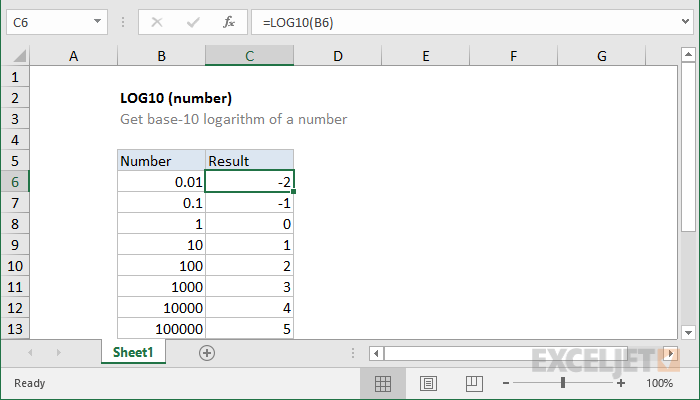
LOG10 returns the base-10 logarithm of a number. In simple terms, it answers the question: "10 raised to what power gives me this number?" The table below shows how LOG10 works and how it is related to raising 10 to a specific power:
| Number | LOG10 | Because |
|---|---|---|
| 1000 | 3 | 10³ = 1000 |
| 100 | 2 | 10² = 100 |
| 10 | 1 | 10¹ = 10 |
| 1 | 0 | 10⁰ = 1 |
| 0.1 | -1 | 10⁻¹ = 0.1 |
| 0.01 | -2 | 10⁻² = 0.01 |
For numbers that aren't exact powers of 10, LOG10 will return get decimals:
| Number | LOG10 |
|---|---|
| 50 | 1.699 |
| 3697 | 3.568 |
| 0.3697 | -0.432 |
To use Excel's LOG10 function, just supply a number:
=LOG10(1000) // returns 3
=LOG10(100) // returns 2
=LOG10(10) // returns 1
=LOG10(1) // returns 0
=LOG10(0.1) // returns -1
=LOG10(0.01) // returns -2