Summary

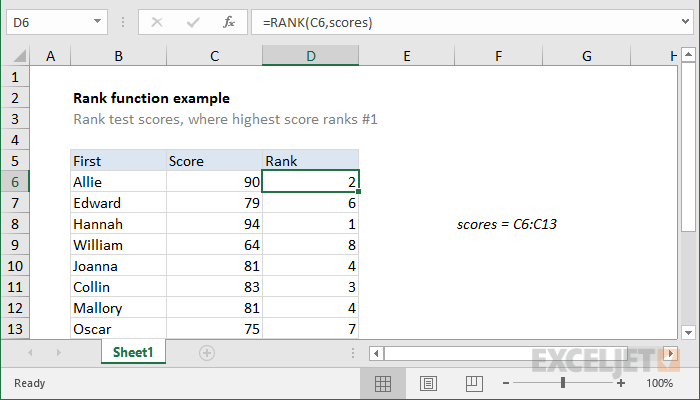
To rank a set of numeric values, where the highest value is ranked #1, you can use the RANK function. In the example shown, the formula in D6 is:

=RANK(C6,scores)

Where scores is the named range C6:C13.

Generic formula

=RANK(value,data)

Explanation

You can use the RANK function to rank numeric values.

RANK has two modes of operation: ranking values where the largest value is #1 (order = 0), and ranking values where the lowest value is #1 (order = 1).

In this case, we are ranking test scores, so the highest value should rank #1, so we omit the order argument, which defaults to zero:

=RANK(C6,scores)

The following formula, which includes order set to zero, is equivalent:

=RANK(C6,scores,0)

Video: How to rank values with the RANK function (3 min, free). It's one of 117 lessons in our Core Formula course.

Support Exceljet

Many websites (including Exceljet) have lost over half their traffic in the past year because of the crushing impact of AI on web searches. Exceljet is still at it, publishing free content each week. If you find Exceljet helpful, you can support the site and go ad-free with the Exceljet Lifetime Pass. One payment, no subscription, and ads are gone forever. Plus, you get our Excel Shortcuts video course as a thank you.

Get the Lifetime Pass

Dave Bruns Profile Picture

AuthorMicrosoft Most Valuable Professional Award

Dave Bruns

Hi - I'm Dave Bruns, and I run Exceljet with my wife, Lisa. Our goal is to help you work faster in Excel. We create short videos, and clear examples of formulas, functions, pivot tables, conditional formatting, and charts.