Summary
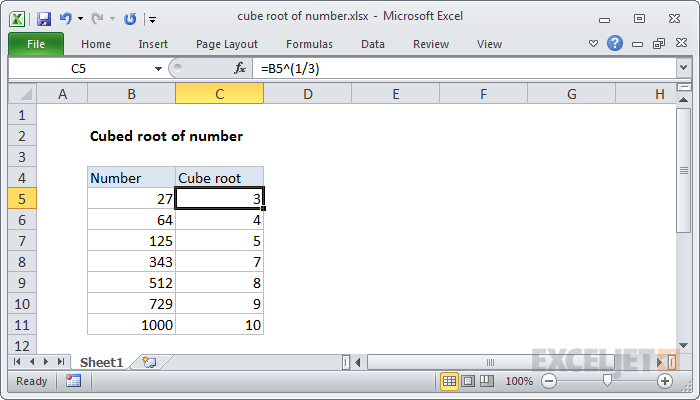
To get the cube root of a number, you can use the caret(^) operator with 1/3 as the exponent in a simple formula. In the example shown, the formula in C5 is:
=B5^(1/3)
Generic formula
=number^(1/3)
Explanation
The cube root of a number can be calculated manually with the exponentiation operator (^) or with the POWER function.
Manually with ^
The cube root of a number can be calculated manually by raising a number to the (1/3) using the exponentiation operator (^). In the example shown, the formula in C5 is:
=B5^(1/3)
Be sure to enclose 1/3 in parentheses to control the order of operations.
For background on fractional exponents, see Basic fractional exponents on Khan Academy.
With the POWER function
The cube root of a number can also be calculated with the POWER function, by supplying 1/3 as the power argument. The equivalent formula is:
=POWER(B5,1/3)