
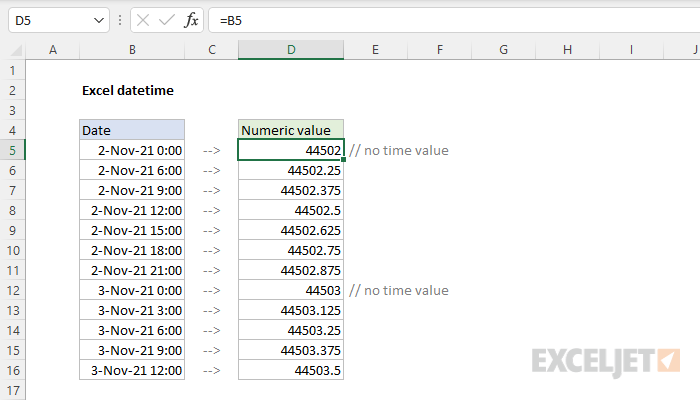
In Excel's date system, dates are serial numbers and times are fractional parts of one day. When a value contains both a date and a time together, it is sometimes called a "datetime". For example, the date November 2, 2021 corresponds to the serial number 44502. If we create this date with the DATE function, it returns 44502:
=DATE(2021,11,2) // returns 44502
When a date format is applied to this value in a cell, the number 44502 can be displayed as "November 2, 2021", "2-Nov-21", etc.
If the number is instead 44502.5, it is called a "datetime" because it contains both a date and time. This is equivalent to the following formula:
=DATE(2021,11,2)+TIME(12,0,0) // returns 44502.5
If a date format that includes time is applied to a cell with that contains 44502.5, the value can be displayed as "November 2, 2021 12:00", "Nov 2 12:00 PM", etc.
In short, any date serial number that includes a decimal value can be considered a datetime.