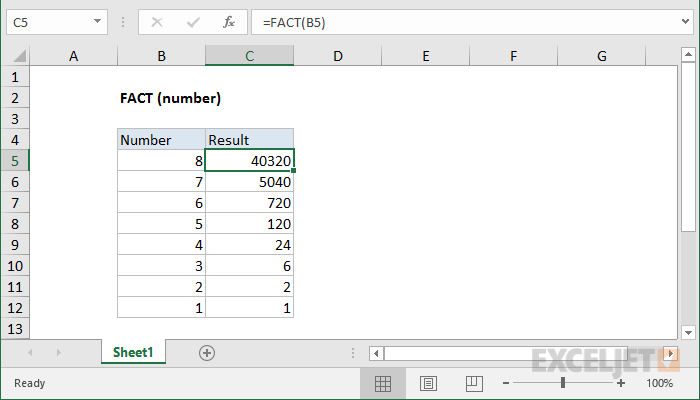
=FACT(number)- number - The number to get the factorial of.
Using the FACT function
The Excel FACT function returns the factorial of a given number. A factorial is the product of a whole number and all the positive whole numbers below it. It is written with an exclamation point, like 3!, which is pronounced "three factorial". For example, three factorial is calculated like this:
3! = 3 × 2 × 1 = 6
Here are the factorials for four, five, and six:
4! = 4 × 3 × 2 × 1 = 24
5! = 5 × 4 × 3 × 2 × 1 = 120
6! = 6 × 5 × 4 × 3 × 2 × 1 = 720
In Excel, you use the FACT function to calculate a factorial. FACT takes just one argument, number, which should be a positive integer. If number is not an integer, the decimal portion of number will be removed before the factorial is calculated.
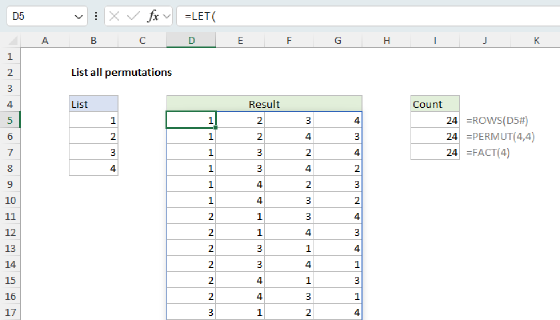
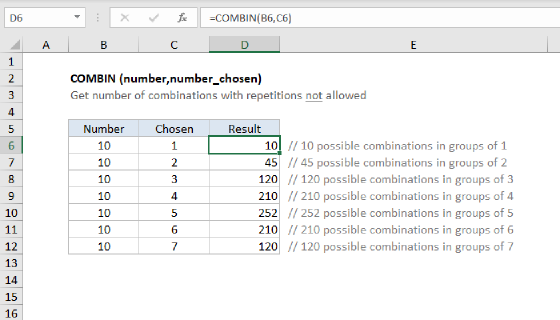
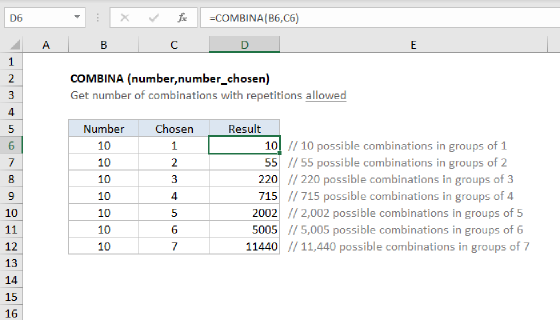
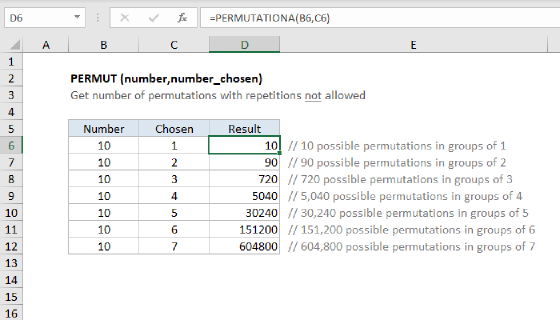
Factorials are the building block behind the formulas used to count combinations and permutations. For a full explanation, see Combinations and permutations in Excel.
Examples
=FACT(3) // returns 6
=FACT(4) // returns 24
=FACT(5) // returns 120
=FACT(6) // returns 720
If number is not an integer it will be truncated to an integer:
=FACT(3.2) // returns 6
When number is zero, FACT returns 1:
=FACT(0) // returns 1
If number is negative, FACT returns the #NUM! error:
=FACT(-3) // returns #NUM!
Notes
- Number cannot be negative or FACT will return the #NUM! error.
- If number is not an integer it will be truncated to an integer, then solved.