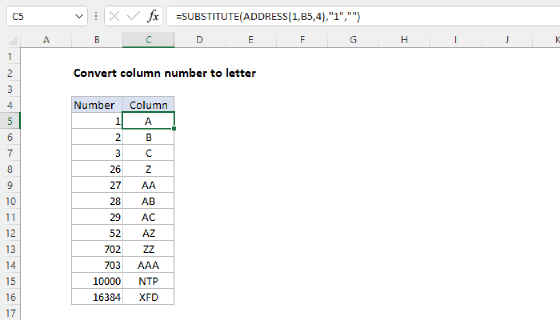
Summary

To convert a column letter to an regular number (e.g. 1, 10, 26, etc.) you can use a formula based on the INDIRECT and COLUMN functions.

In the example shown, the formula in C5 is:

=COLUMN(INDIRECT(B5&"1"))

Generic formula

=COLUMN(INDIRECT(letter&"1"))

Explanation

The first step is to construct a standard "A1" style reference using the column letter, by adding a "1" with concatenation:

B5&"1"

This results in a text string like "A1" which is passed into the INDIRECT function.

Next, the INDIRECT function transforms the text into a proper Excel reference and hands the result off to the COLUMN function.

Finally, the COLUMN function evaluates the reference and returns the column number for the reference.


Support Exceljet

Many websites (including Exceljet) have lost over half their traffic in the past year because of the crushing impact of AI on web searches. Exceljet is still at it, publishing free content each week. If you find Exceljet helpful, you can support the site and go ad-free with the Exceljet Lifetime Pass. One payment, no subscription, and ads are gone forever. Plus, you get our Excel Shortcuts video course as a thank you.

Get the Lifetime Pass

Dave Bruns Profile Picture

AuthorMicrosoft Most Valuable Professional Award

Dave Bruns

Hi - I'm Dave Bruns, and I run Exceljet with my wife, Lisa. Our goal is to help you work faster in Excel. We create short videos, and clear examples of formulas, functions, pivot tables, conditional formatting, and charts.