
Summary
Excel can use a custom template for all new workbooks. If you find yourself making the same changes to every new workbook (margins, page setup, font size, zoom, etc.) a default template can save you time and trouble. This article explains how to set up a default template in Excel on both Windows and Mac.
Do you find yourself creating new workbooks in Excel, then making the same changes to each one? Maybe you always adjust the margins and page setup, change the font size, or set a different zoom level? A default template solves this problem: as long as the template has the right name and sits in the right folder, Excel will use it for every new workbook you create.
This is one of those features that most people never think about until they need it. Then they assume there must be a simple setting somewhere, and instead discover that the official method involves a hidden "startup folder" buried deep in the file system. The location of this folder varies by platform and version, and finding it is the hardest part of the whole exercise. The good news: you can skip that tedious search entirely by telling Excel to use a folder that you create, in a location that makes sense to you. That is the method I recommend below, and the method I use myself on both Windows and Mac (verified August 2026). The official startup folder is also covered, if you prefer a zero-configuration option.
Table of Contents
- How templates work in Excel
- Settings you can save in a template
- Recommended: use your own startup folder
- Alternative: the official startup folder
- Find the startup folder with VBA
- Test your template
- Template for new sheets
- Localized template names
How templates work in Excel
A template is a special kind of workbook file that works as a master copy. When you open a template, Excel does not open the file itself. Instead, Excel creates a new, unsaved workbook based on the template (Book1, Book2, etc.) and the template file stays untouched. Standard templates use the .xltx extension; templates that contain macros use the .xltm extension.
Normally, using a template is a manual step: you pick the template when you create a new file. On Windows, this is what the Custom Office Templates folder in your Documents folder is for: templates saved there appear as options when you create a new workbook, but they are never applied automatically. A default template is different: Excel applies the template automatically. To make this work, Excel looks in its startup folders for two reserved file names each time it launches:
- Book.xltx: used as the template for new blank workbooks
- Sheet.xltx: used as the template for sheets inserted into an existing workbook
These names are required, and they are language-specific: Book.xltx and Sheet.xltx are the names for English versions of Excel. If you run Excel in another language, you will need the localized equivalents, explained in Localized template names below. A template with any other name sitting in a startup folder will not become a default; Excel will simply open a new copy of it at startup, like any other file. The reserved names work the same way in the official startup folder and in a custom startup folder that you set yourself, because the "open all files at startup" option (explained below) effectively registers your own folder as an additional startup folder, with the same rules.
Settings you can save in a template
A template can hold many custom options. Here are examples of settings that can be saved in a workbook template:
- Page setup options, including margins, orientation, scaling, and print area
- Headers and footers
- The document theme (theme colors, fonts, and effects)
- Font formatting, cell styles, and number formats
- Column widths and row heights
- Display options and zoom settings
- The number (and type) of sheets in new workbooks
- Placeholder text (titles, column headers, etc.)
- Data validation settings
- Macros, hyperlinks, and ActiveX controls (macros require the .xltm format)
- Workbook calculation options
These settings only apply to new workbooks created after the template is installed. Existing workbooks are not affected. See below for a tip on setting defaults for new sheets added to an existing workbook.
Recommended: use your own startup folder
Instead of burying your template deep in an application folder, you can tell Excel to look in a folder you create yourself. This works the same way on Windows and Mac, and it keeps your template somewhere visible, easy to back up, and easy to find later.
- Create a folder in a convenient location, for example Documents > xlstart.
- Open a new blank workbook and customize the options as you like.
- Save the workbook into your new folder as an Excel template named "Book" (Excel will add the .xltx extension). If your template contains macros, save it as a macro-enabled template (.xltm) instead.
- Tell Excel to open files from this folder at startup:
- Windows: go to File > Options > Advanced > General > At startup, open all files in, and enter the path to your folder.
- Mac: go to Excel > Preferences > General > At startup, open all files in, and select your folder.
- Windows only: disable the Start screen at File > Options > General > Start up options by unchecking "Show the Start screen when this application starts". The Start screen can prevent Excel from using a custom template.
- Quit and relaunch Excel, then test to confirm that new workbooks are based on your template.
Careful with the name: the file is Book.xltx, not Book1.xltx. Excel names new workbooks "Book1", "Book2", and so on, so the number looks like it belongs. It doesn't, and Excel will silently ignore a template named Book1.xltx. The same rule applies to Sheet.xltx below.
Watch the save location! In the Save As dialog, you might notice a folder named Custom Office Templates. That folder is for templates you pick manually with File > New; it is not a startup folder, and a template saved there will not become a default template. Make sure you navigate to your own startup folder before you save.
Excel will try to open every file in this folder each time it starts, so keep the folder dedicated to your template file(s) only.
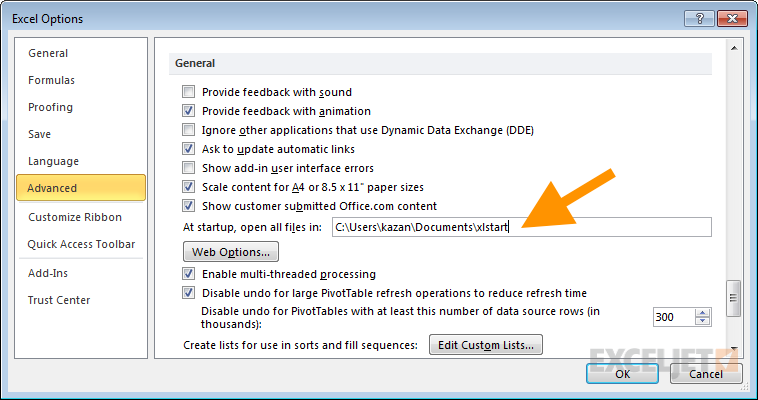 Setting a custom startup folder on Windows...make sure you use the correct path on your computer!
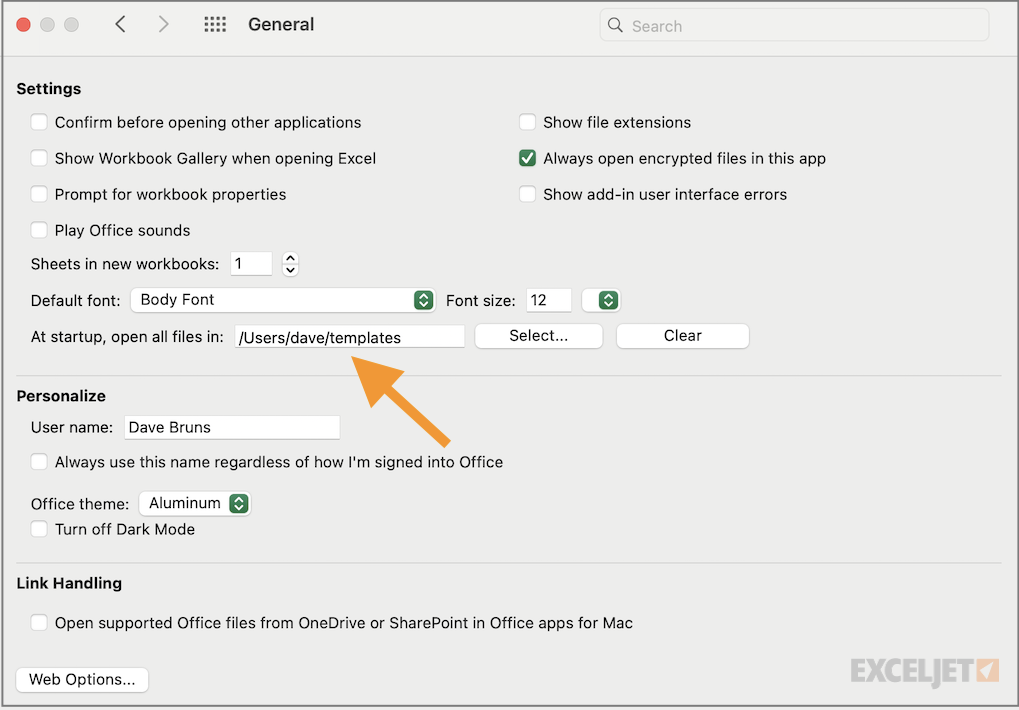 Setting a custom startup folder on the Mac...the folder can live anywhere you like
If you use a non-English version of Excel, the template must have a localized name. For example, in the Dutch version of Excel, the workbook template is named "Map.xltx" instead of "Book.xltx". See Localized template names below.
Alternative: the official startup folder
Whenever Excel is launched, it checks a special "startup folder" for templates. If you drop a template named "Book.xltx" into this folder, Excel will use it for all new workbooks with no configuration at all. The catch is finding the folder.
On Windows, the startup folder is named XLSTART. The most common location is inside your user profile:
- C:\Users\username\AppData\Roaming\Microsoft\Excel\XLSTART
There is also an installation-wide XLSTART folder inside the Microsoft Office program folder, but the exact path varies with the version of Office installed. If you can't find XLSTART, see the VBA trick below.
On the Mac, modern versions of Excel keep the startup folder inside the application's container, at a location only a programmer could love:
- ~/Library/Group Containers/UBF8T346G9.Office/User Content/Startup/Excel
To get there in the Finder, hold down the Option key, click the Go menu, and choose Library (the Library folder is hidden by default). The template must be named "Book.xltx" (or "Book.xltm" with macros). See Customize how Excel starts in Excel for Mac for Microsoft's documentation.
Find the startup folder with VBA
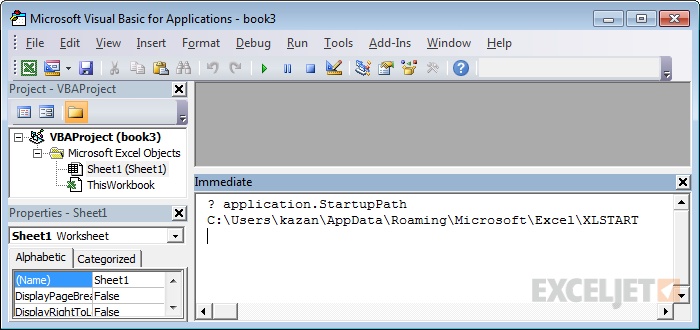
If you can't locate the startup folder for Excel, you can use VBA to confirm the startup path like this:
- Run Excel
- Open the VBA editor (Alt + F11)
- Open the Immediate Window (Control + G)
- Type:
? application.StartupPathin the window - Press Enter
The startup path will appear below the command. This trick works on both Windows and Mac. Once you've confirmed the location of the startup folder, drop in your template file.
Test your template
After you set up a default template, make sure you test to confirm your template is being used. One easy way to do this is to (temporarily) give cell A1 in your template a bright yellow or orange fill. That way, you can immediately see if your custom template is being used when you create a new workbook. Once you're sure things are working, remove the marker.
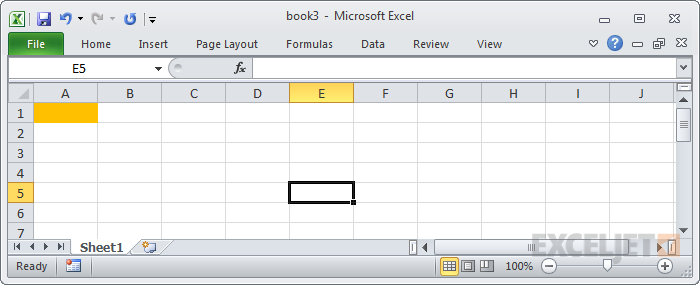
If your template is not loading on Windows, check whether the Start screen is enabled at File > Options > General > Startup options. If so, uncheck "Show the Start screen when this application starts". I ran into this myself on a new Windows 11 machine in 2025: book.xltx was in the correct location, but the Start screen prevented Excel from using it. Also double-check the file name itself: it must be Book.xltx, not Book1.xltx.
Template for new sheets
A workbook template controls the sheets already in a new workbook, but not sheets you insert later. When you insert a new sheet, it will inherit Excel's sheet defaults. If you want to control new sheets with your own template, follow the process below:
- Open a new blank workbook and delete all sheets except one.
- Make desired customizations to the sheet.
- Save the file as an Excel template named "Sheet" (Sheet.xltx) in the same startup folder as your workbook template. Like Book.xltx, the reserved name Sheet.xltx works in both a custom startup folder and the official startup folder.
- Close the file.
To test that the sheet template is working, open a workbook and add a new sheet. You should see your customizations in all newly inserted sheets. As with the workbook template, the file name must be localized in non-English versions of Excel, as explained below.
Localized template names
The reserved names Book.xltx and Sheet.xltx only work in English versions of Excel. Other language versions expect different names, and a template with the English name will simply be ignored. Luckily, there is a simple rule you can use to work out the correct names in any language: the template name matches the default name that Excel uses in your language, without the number. To check the names Excel expects:
- Create a new blank workbook and look at the name in the title bar. In English, this is "Book1", so the workbook template is Book.xltx. In Dutch, a new workbook is "Map1", so the template is Map.xltx.
- Look at the tab name of the first sheet. In English, this is "Sheet1", so the sheet template is Sheet.xltx. In Dutch, the first sheet is "Blad1", so the template is Blad.xltx.
The table below shows the correct template names for a few common languages:
| Language | Workbook template | Sheet template |
|---|---|---|
| English | Book.xltx | Sheet.xltx |
| Dutch | Map.xltx | Blad.xltx |
| French | Classeur.xltx | Feuil.xltx |
| German | Mappe.xltx | Tabelle.xltx |
| Spanish | Libro.xltx | Hoja.xltx |
| Czech | Sešit.xltx | List.xltx |
Note that the name must match the default name exactly, even when Excel uses an abbreviation. For example, in French, the word for sheet is "feuille", but sheet tabs are named "Feuil1", "Feuil2", etc. As a result, the sheet template must be named Feuil.xltx; the name Feuille.xltx will not work. When in doubt, trust the names you see in the title bar and sheet tabs, not the dictionary. Templates that contain macros use the same localized names with the .xltm extension.